
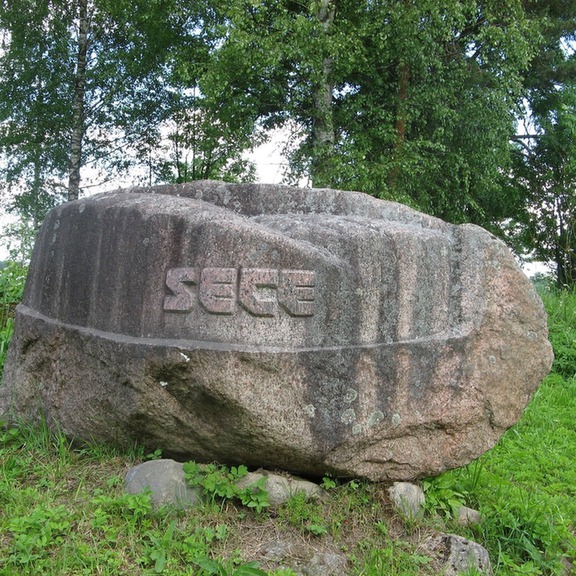
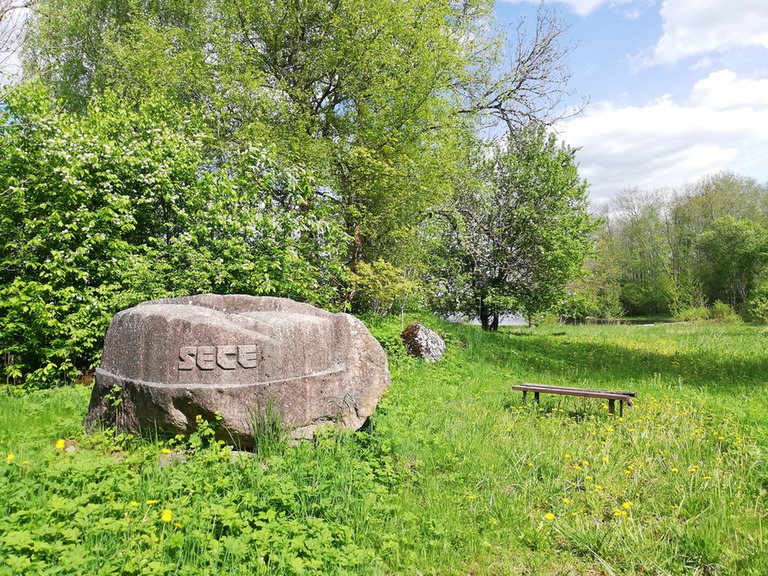
Daugava river stone
Seces pagasts, Aizkraukles novads, Latvija, LV-5124An interesting local legend has been preserved about the Daugava (Sece) Stone, explaining both the name of the stone and the relationship between Sece and the River Daugava.
According to the legend, in ancient times the Daugava flowed much closer to Sece, and the people of Sece hoped that the mighty river would one day run directly through their land. However, the river chose another course and passed the parish by. As a result, people began to say that the Daugava had “flowed past Sece.” From this story originated both the name of the place and the name of the Daugava (Sece) Stone.
Today, this site is marked by the Daugava Stone, created by sculptor Vilnis Titāns. The monument indicates the point where the river comes closest to Sece Parish, yet never actually crosses its territory.
The legend is also told in a more symbolic way. It is said that the Daugava once intended to turn towards Sece, but on its way encountered high banks and rolling hills. Saddened, the river bid farewell to Sece and continued on its journey, leaving behind a stone as a reminder of a meeting with this land that never came to pass.
It should be noted, however, that this legend is often used as a poetic explanation of the saying: “The Daugava passed Sece by.”
This play on words has become one of the best-known stories and symbols of Sece Parish.


- Aizkraukle municipality and Koknese Tourism Information centre
1905. gada iela 7, Koknese
(+371) 29275412, (+371) 65161296 - Aizkraukle Tourism Information point
Lāčplēša iela 4, Aizkraukle
(+371) 25727419 - Jaunjelgava Tourism Information point
Jelgavas iela 33, Jaunjelgava
(+371) 27366222 - Pļavinas Tourism Information point
Daugavas iela 49, Pļaviņas
(+371) 22000981 - Skrīveri Tourism Information Point
Daugavas iela 85, Skrīveri, Skrīveru pagasts
(+371) 25661983 - Staburags Tourism Information point
Staburaga saieta nams, 2. stāvs, Staburags, Staburaga pagasts
(+371) 29892925 - Nereta Tourism Information point
Dzirnavu iela 5, Nereta, Neretas pagasts
(+371) 26674300 - Mazzalve Tourism Information point
Skolas iela 1, Ērberģe, Mazzalves pagasts
(+371) 26156535 - Irši Manor Barn - Magazina
Irši, Iršu pagasts
(+371) 29275412
