Sērene karst fall
- Sērenes pagasts, Aizkraukles novads, Latvija, LV-512
- 56.568977, 25.233927
- Waze
- Google maps
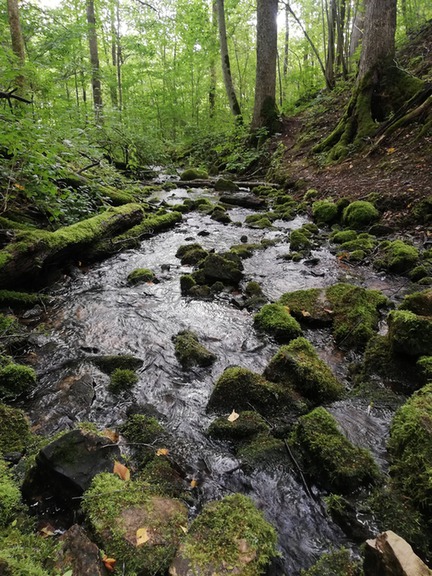
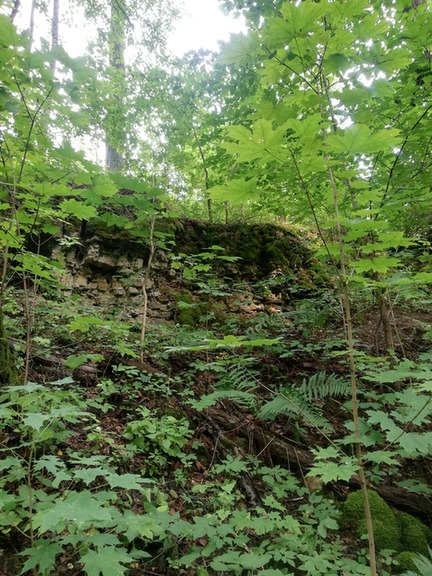
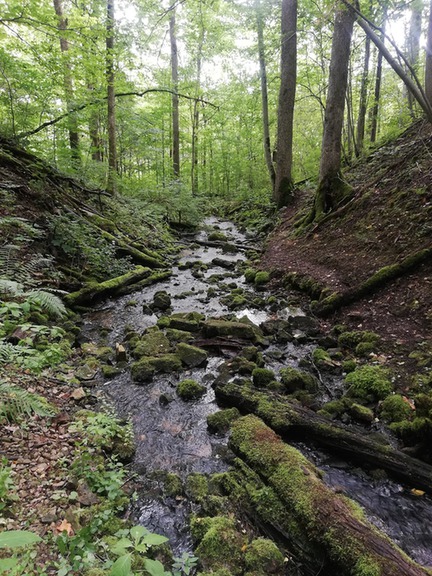
The Sērene karst fall, located on the slope of the Lauce River valley, is the discharge point of a seasonal spring within an old quarry. Exposed layers of the Pļaviņas Formation dolomite can be clearly observed here. At the very bottom of the sinkhole lies the outlet of the seasonal spring.
The best time to visit is in spring, when the spring forms a lively brook whose cheerful murmuring fills the surrounding area. Like a blue carpet, wood anemones decorate the edges of the ravine slopes, allowing visitors to experience the vibrancy and vividness of spring. Visitors have the opportunity to follow the spring stream all the way to where it flows into the Lauce River, enjoying the surrounding natural landscape along the way.
The karst sinkhole was formed through the washing out and dissolution of gypsum-bearing rocks. Over time, a large funnel-shaped cavity developed underground, initially covered by a thin layer of soil, which eventually collapsed. Karst processes take place in underground structures containing soluble mineral salts, primarily through the dissolution of limestone, dolomite, or gypsum. Groundwater gradually washes these minerals away, carrying dissolved substances into surface water bodies. As minerals dissolve, underground voids, fractures, and subterranean lakes form. When the surface layer collapses into these voids, a karst depression—or sinkhole—is created. The term “kritenis” is considered a regional expression from the Selonian dialect.
The karst fall is easily accessible, with directional signs in place and a parking area located by the roadside. Visitors should be prepared for a steep descent when approaching the site and are advised to wear comfortable footwear. To the north, at a relatively short distance, lies the unique dry riverbed of the Korkuļi River, featuring swallow holes.
- Aizkraukle municipality and Koknese Tourism Information centre
1905. gada iela 7, Koknese
(+371) 29275412, (+371) 65161296 - Aizkraukle Tourism Information point
Lāčplēša iela 4, Aizkraukle
(+371) 25727419 - Jaunjelgava Tourism Information point
Jelgavas iela 33, Jaunjelgava
(+371) 27366222 - Pļavinas Tourism Information point
Daugavas iela 49, Pļaviņas
(+371) 22000981 - Skrīveri Tourism Information Point
Daugavas iela 85, Skrīveri, Skrīveru pagasts
(+371) 25661983 - Staburags Tourism Information point
Staburaga saieta nams, 2. stāvs, Staburags, Staburaga pagasts
(+371) 29892925 - Nereta Tourism Information point
Dzirnavu iela 5, Nereta, Neretas pagasts
(+371) 26674300 - Mazzalve Tourism Information point
Skolas iela 1, Ērberģe, Mazzalves pagasts
(+371) 26156535 - Irši Manor Barn - Magazina
Irši, Iršu pagasts
(+371) 29275412